Your First Japanese Knife: The Beginner's Buying Guide
Quick Takeaway
- One good knife, not a set. A gyuto (210mm) or santoku (165 to 170mm) covers 80% of tasks.
- Stainless for beginners: VG-10 and Ginsan forgive you if you forget to dry immediately. Carbon rusts.
- Budget: Tojiro DP Gyuto 210mm. Mid range: MAC MTH-80 Gyuto 200mm. Premium: Takamura R2 Gyuto 210mm.
- Avoid “Japanese style” knives from brands that don’t make anything in Japan. If the steel type isn’t listed, that’s a red flag.
Why One Knife Is Enough
You don’t need a knife set. Most home cooks reach for the same knife 90% of the time. A gyuto or santoku handles vegetables, meat, fish, herbs, and everything in between.
Buy one knife you’ll enjoy using. Get comfortable with it. Add a petty knife later if you want something smaller for detail work. That’s it.
Gyuto or Santoku: Which One?
Both are all purpose knives. The difference comes down to shape and technique.
A gyuto has a curved belly and a pointed tip. It rocks and slices naturally, and the longer blade (typically 210mm) moves through larger ingredients faster. If you do a lot of protein work or cook for more than two people regularly, start here.
A santoku is shorter (165mm to 180mm), flatter, and wider. It excels at the up and down chopping motion and scoops food off the cutting board easily. If you mostly prep vegetables, have smaller hands, or prefer a compact knife, this is the better pick.
Neither is objectively better. But if you can only own one and you’re not sure, go with the gyuto. It’s more versatile across different ingredients and cutting techniques. For a deeper look at each knife type and what it’s designed for, see our guide to Japanese knife types.
What to Look For
Steel Type
For a first knife, stick with stainless steel. Carbon steel takes a sharper edge and has its own appeal, but it rusts, it stains, and it needs more attention than most beginners want to give. You can always explore carbon later.
Good stainless options for beginners:
- VG-10: The industry standard. Hard enough to hold a good edge (around 60 HRC), easy to sharpen, widely available. You’ll find it in knives from Tojiro, Shun, and Sakai Takayuki.
- Ginsan (Silver #3): Stainless steel that sharpens almost like carbon. Slightly less common but excellent. Used by Sakai Takayuki and Tanaka.
- SG2 / R2: Powdered steel that holds an edge longer than VG-10. Shows up in mid range and premium knives from Takamura and Miyabi.
For a deeper breakdown of each steel, see our steel types guide.
Handle Style
Two options: wa (Japanese, typically octagonal or D shaped wood) and yo (Western, riveted, contoured).
Wa handles are lighter and shift the balance toward the blade. Yo handles feel more familiar if you’re coming from Western knives. Neither is better. Hold both if you can. If you can’t, yo handles are a safe starting point since you already know how they feel.
Blade Length
For a gyuto: 210mm is the sweet spot. Long enough to be useful, short enough to be manageable. 240mm is popular with experienced cooks but can feel unwieldy at first.
For a santoku: 165mm to 180mm. The shorter length is the whole point of this knife.
Authenticity
This matters more than most buyers realize. A knife made in Seki, Sakai, Tsubame Sanjo, or Echizen by a known maker, using identifiable steel, is a very different product from a “Japanese style” knife stamped in a factory overseas with vague marketing copy.
Check for: a named maker or production region, a specific steel type, and a brand with a verifiable history. If the listing can’t tell you where the knife was made or what steel it uses, move on. Our guide on what makes Japanese knives special covers the craftsmanship differences in detail.
Budget Tier: Under $80
This is where most people should start. These knives are genuinely good, not “good for the price.” They’re made in Japan by established companies, and they’ll outperform any Western knife at the same price.
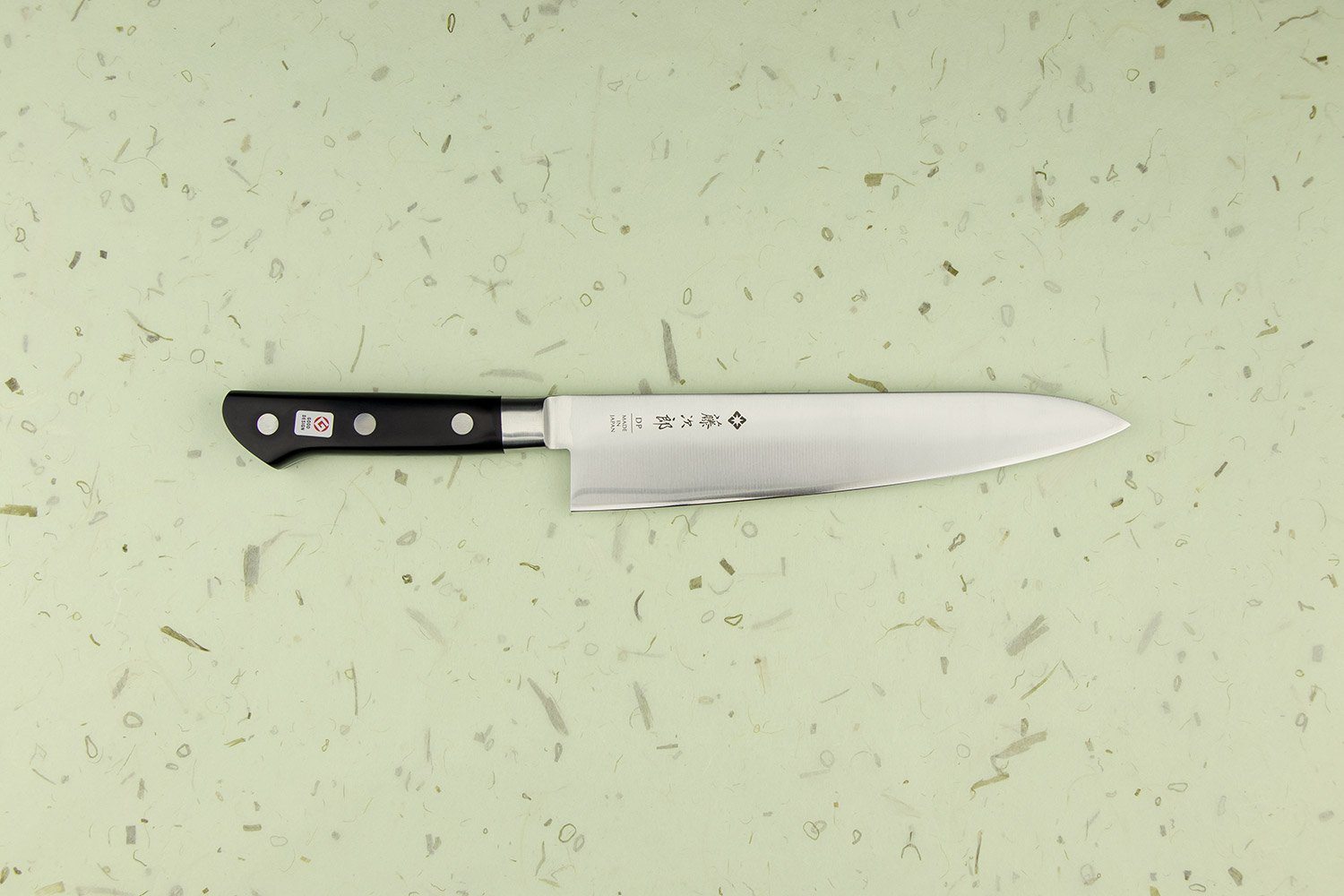
Tojiro DP Gyuto 210mm
Tojiro
Tojiro DP Gyuto 210mm
The default recommendation in every knife community, and for good reason. VG-10 core steel with a stainless cladding, made in Tsubame Sanjo. The fit and finish are basic but functional. The edge geometry is excellent out of the box.
Tojiro DP Gyuto 210mm is the bridge knife. It feels familiar enough coming from Western knives (yo handle, moderate weight) but cuts like a Japanese blade. If you’re not sure what you want and you want to spend the least amount of money figuring it out, start here.
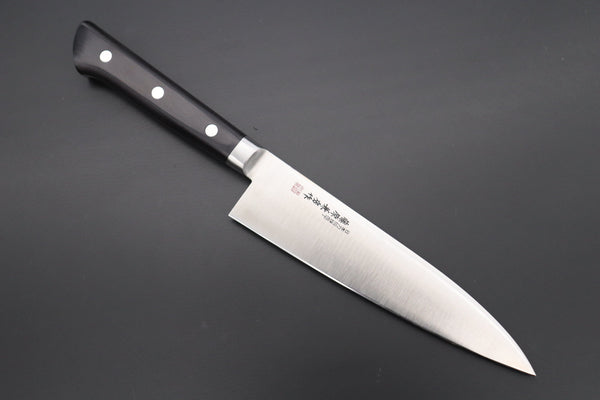
Fujiwara FKM Gyuto 210mm
Fujiwara FKM
Fujiwara FKM Gyuto 210mm
The other go to budget pick. Fujiwara FKM Gyuto 210mm uses AUS-8 molybdenum vanadium stainless steel, made by Fujiwara Kanefusa in Seki. Softer than VG-10 (around 58 to 59 HRC), which means it’s even easier to sharpen. The trade off is you’ll sharpen a bit more often.
The handle is plain, the look is no frills. That’s fine. You’re paying for the blade, and the blade delivers.
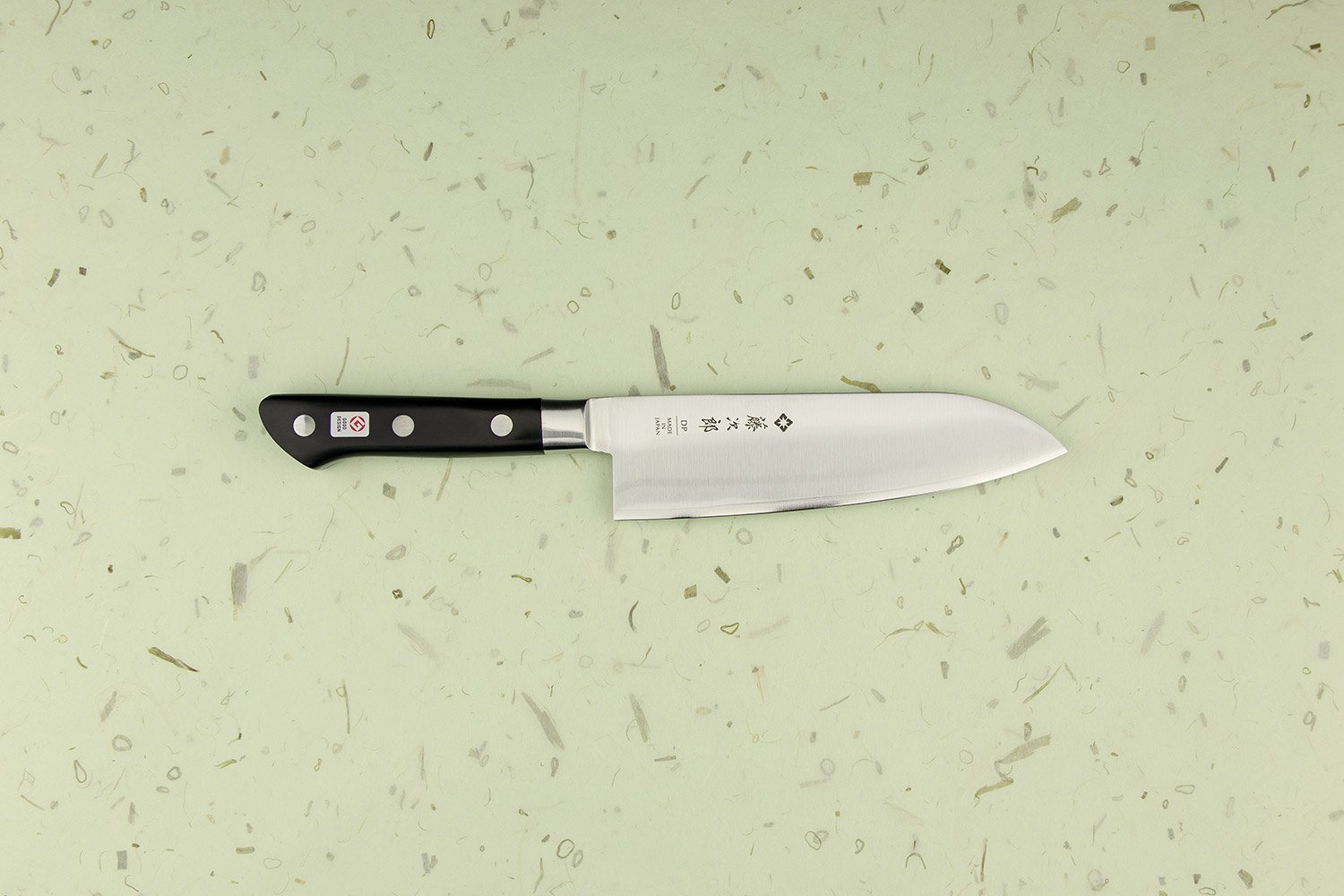
Tojiro DP Santoku 170mm
Tojiro
Tojiro DP Santoku 170mm
If you prefer a santoku, Tojiro DP Santoku 170mm is the budget pick. Same VG-10 steel and construction as the gyuto. A solid, unpretentious knife that handles daily vegetable prep reliably.
Mid Range: $80 to $200
This tier is where you start feeling what separates a good knife from a great one. Better steel, better grinds, better handles. The knives here are noticeably thinner behind the edge, which translates directly into less resistance when cutting.
MAC MTH-80 Professional Gyuto 200mm

MAC
MAC Professional MTH-80 Gyuto 200mm
MAC MTH-80 Professional Gyuto 200mm is a quiet legend. MAC doesn’t do flashy marketing. They make thin, light, razor sharp knives that professional cooks quietly swear by. The blade is ground thin, the edge retention is solid, and it’s easy to maintain. If “just works, every time” is what you’re after, this is the knife.
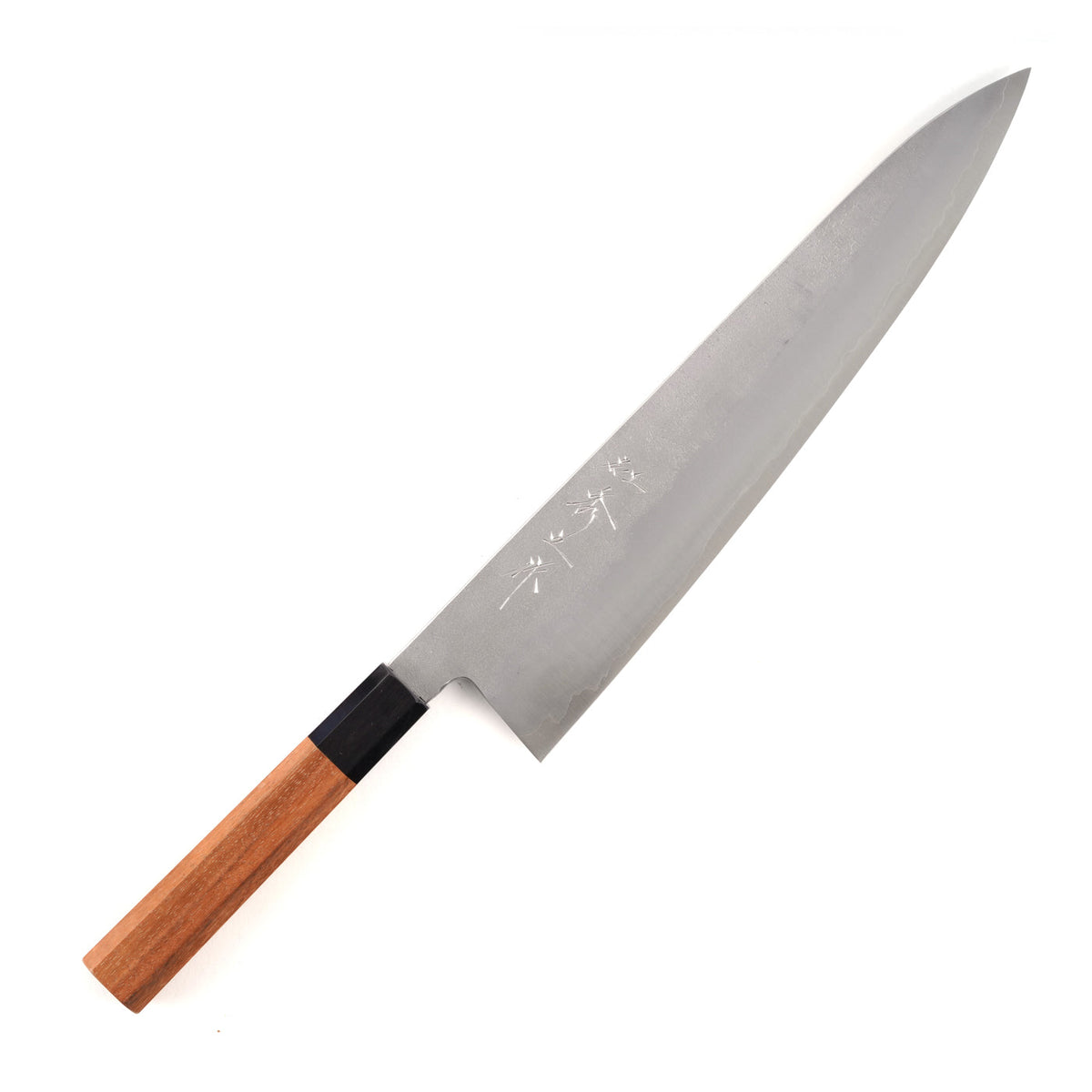
Tanaka Ginsan Gyuto 210mm
Sakai Takayuki
Tanaka Ginsan Gyuto 210mm
Your first step into the world of traditional Japanese knife making. Tanaka Ginsan Gyuto 210mm uses Ginsan (Silver #3) steel, which sharpens almost as well as carbon but resists rust. The nashiji (pear skin) finish reduces food sticking, and the wa handle shifts weight toward the blade for a more precise feel.
Made in Echizen by Tanaka, a well respected maker. This is where you start to understand why people get obsessed with Japanese knives.
Sakai Takayuki 45 Layer Damascus Gyuto 210mm

Sakai Takayuki
Sakai Takayuki 45-Layer Damascus Gyuto 210mm
If aesthetics matter to you alongside performance, Sakai Takayuki 45-Layer Damascus Gyuto 210mm delivers both. VG-10 core with a 45 layer damascus pattern, wa handle, made in Sakai. The damascus cladding is functional (it adds stain resistance and reduces drag) and it happens to look striking.
Sakai Takayuki has been making knives in Sakai for decades. This is the real thing, not decorative damascus slapped on generic steel.
Other Mid Range Options Worth Considering
- Global G-2 Gyuto 200mm: One piece stainless design, distinctive dimpled handle. You either love the feel or you don’t. Light, nimble, easy to maintain.
- Shun Classic Gyuto 200mm: VG-10 with damascus cladding. Widely available, solid performer. The D shaped handle suits right handed users well.
- Yoshikane SKD Gyuto 210mm: Semi stainless SKD steel from Echizen. A workhorse knife that takes a fantastic edge. Less well known, highly regarded in enthusiast communities.
Premium: $200 and Up
You don’t need to spend this much on your first knife. But if you’ve done the research, you know what you want, and you’d rather buy once, these knives reward you every time you pick them up.
Takamura R2 Gyuto 210mm
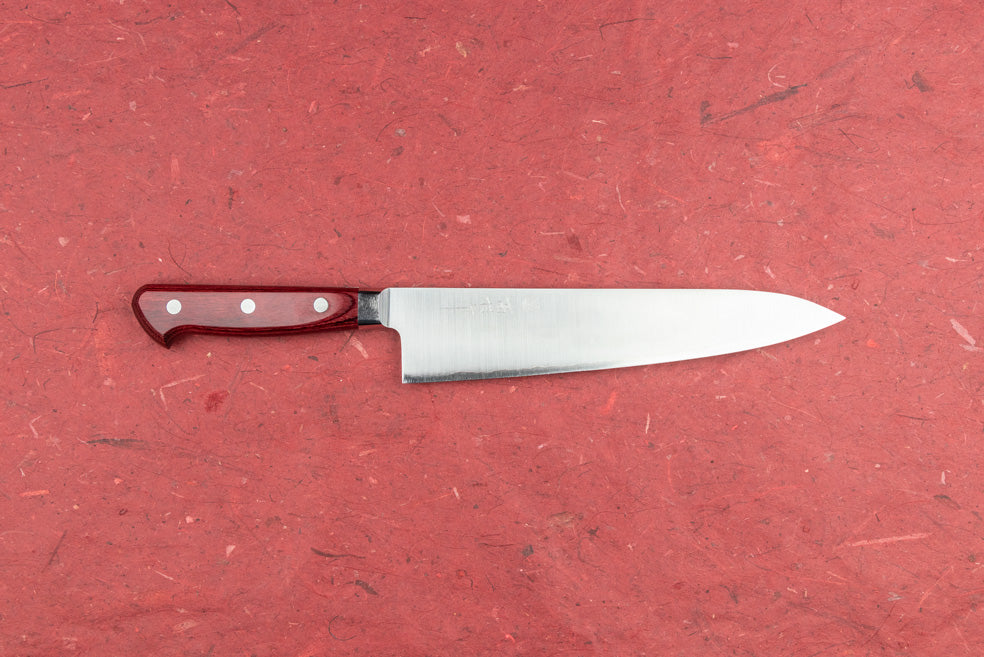
Takamura
Takamura R2 Gyuto 210mm
Takamura R2 Gyuto 210mm is extraordinarily thin and laser sharp. SG2 powdered steel hardened to around 63 HRC, which means it holds its edge for a long time. The blade is so thin it glides through ingredients with almost no resistance.
The trade off: thin blades are more delicate. This isn’t the knife for splitting squash or rocking through bones. But for precise vegetable work and protein portioning, it’s hard to beat at any price.
Made by Takamura in Echizen.
Masakage Yuki Gyuto 210mm

Masakage
Masakage Yuki Gyuto 210mm
Masakage Yuki Gyuto 210mm uses Shirogami #2 (White Carbon Steel #2), which is carbon steel. Yes, this recommendation breaks the “stainless for beginners” rule. Here’s why it’s included: the kurouchi (forge) finish protects most of the blade from corrosion, and Shirogami #2 is one of the easiest steels to sharpen, taking a remarkably keen edge. If you’re the type of person who reads a 3,000 word buying guide before purchasing, you’re probably willing to dry your knife after use.
The wa handle and rustic kurouchi finish give this knife a distinctly traditional feel. Made by Masakage in Echizen.
Misono UX10 Gyuto 210mm
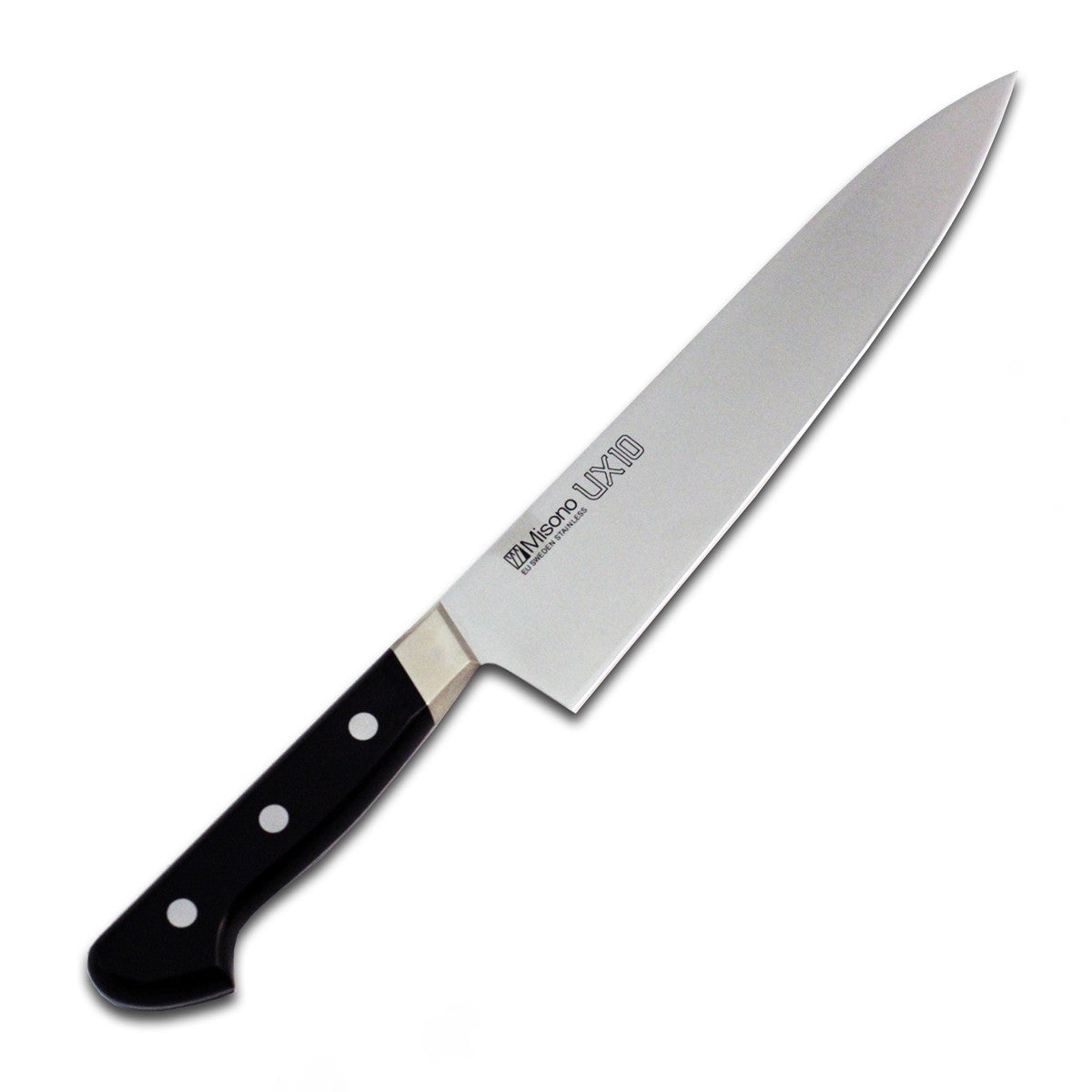
Misono
Misono UX10 Gyuto 210mm
Misono UX10 Gyuto 210mm is the professional’s workhorse. Swedish stainless steel, yo handle, traditional Western profile with Japanese thinness. It’s the knife you see in high end restaurant kitchens across Japan. Excellent edge retention, comfortable for long prep sessions, and built to last years of daily use.
Misono makes knives in Seki and has supplied professionals for decades.
Common Mistakes
Buying a set. Knife sets include knives you’ll never use. Buy one good knife instead of five mediocre ones.
Chasing damascus for its own sake. Damascus is a cladding pattern, not a steel type. It tells you nothing about edge performance. A budget Tojiro with VG-10 will outcut a pricier “damascus” knife with mystery steel. If you want damascus AND good steel, look at what’s underneath the pattern.
Ignoring the handle. A knife that’s uncomfortable in your hand is a knife you won’t use. If you can handle a knife in person before buying, do it.
Using glass cutting boards. This destroys any knife, but Japanese knives especially. Use wood or plastic. End grain wood is ideal.
Not buying a whetstone. Every knife gets dull. A basic 1000 grit whetstone (King 1000 or Shapton Kuromaku 1000) and a YouTube tutorial is all you need to keep your knife sharp for years. Honing rods work on softer Western steel but can chip harder Japanese edges.
Putting it in the dishwasher. Hand wash, dry immediately, done. The dishwasher will damage the handle and dull the edge.
What to Skip
Some brands market “Japanese style” knives that aren’t made in Japan, don’t use identifiable steel, and rely on aggressive social media advertising to move product. Huusk Premium Chef Knife is a notable example: marketed as premium Japanese craftsmanship, but made overseas with unspecified steel. imarku 8-inch Chef Knife and XINZUO 8.5-inch Chef Knife fall into the same category.
These aren’t necessarily terrible knives. But they’re not what they claim to be, and you can get a genuinely Japanese made knife (Tojiro DP Gyuto 210mm, Fujiwara FKM Gyuto 210mm) for the same money or less.
If a brand doesn’t tell you the specific steel type, the maker, or where the knife was made, that silence is telling you something.
The Recommendation
If you want the safest possible first purchase: Tojiro DP Gyuto 210mm. It’s affordable, it’s proven, and it’ll teach you what a sharp Japanese knife feels like without requiring any special maintenance knowledge.
If you can stretch to mid range: MAC MTH-80 Professional Gyuto 200mm or Tanaka Ginsan Gyuto 210mm, depending on whether you want a Western or Japanese handle.
If you want to buy once and buy well: Takamura R2 Gyuto 210mm for stainless precision, or Misono UX10 Gyuto 210mm for a professional workhorse.
Whichever you choose, pair it with a decent cutting board and a whetstone. That’s the whole setup. One good knife, one good board, one sharpening stone. Everything else is optional.