Tsubame-Sanjo Knives: The Metalworking Capital of Japanese Cutlery
Quick Takeaway
- Two cities, one metalworking powerhouse: Tsubame handles tableware, polishing, and stainless steel. Sanjo handles forging, hand tools, and artisan knives. Together they form Japan’s most diverse metalworking cluster.
- 400+ year history: Metalworking in the region began in the early 1600s when flood prone farmers turned to making wakugi (Japanese nails) as a side trade. That evolved into tools, tableware, and eventually kitchen knives.
- Five major knife brands: Tojiro (factory production, VG-10), Global (all stainless, CROMOVA 18), Tadafusa (hand forged, SLD steel), Yoshikane (artisan carbon and semi-stainless), and Mazaki (traditional carbon steel). Each approaches knifemaking differently.
- Factory access: The Tojiro Open Factory, Yoshikin Shop, and annual Kouba no Saiten (Factory Festival) make this one of the most accessible knife regions in Japan for visitors.
- Beyond knives: The region produces everything from Nobel Banquet silverware to Snow Peak camping gear. Metalworking here is broader than any other Japanese knife region.
Two Cities, One Metalworking Capital
Tsubame-Sanjo is not one city. It’s two: Tsubame (population roughly 77,000) and Sanjo (population roughly 95,000), sitting side by side in central Niigata Prefecture. The Shinano River, Japan’s longest, flows through both. The Joetsu Shinkansen connects them to Tokyo in about two hours via Tsubame-Sanjo Station, which despite its name sits within Sanjo’s city limits.
The two cities have distinct metalworking identities, though they share a common origin. Tsubame is the polishing and finishing center, known for stainless steel tableware, cutlery, and the mirror polishing techniques that caught Apple’s attention (Tsubame craftsmen were commissioned to polish the original iPod cases). Sanjo is the forging center, where blacksmiths have been hammering steel into tools and blades for over four centuries.
Together, the area contains more than 5,000 small and medium metalworking companies. Some employ hundreds of workers. Others are one person forges where a single blacksmith shapes steel over a charcoal fire, the same way it’s been done since the Edo period.
For knife enthusiasts, the distinction between the two cities matters. The modern factory producers (Tojiro, Global/Yoshikin) are based in Tsubame. The traditional hand forging operations (Yoshikane, Mazaki, Tadafusa) are based in Sanjo. Understanding which city a knife comes from tells you something about how it was made.
From Nails to Knives: A 400 Year History
The Wakugi Era
The story starts around 1625, during the early Edo period. The Shinano River flooded constantly, devastating rice crops throughout the Tsubame-Sanjo lowlands. Farmers needed a winter trade to survive. Local officials invited nail smiths from Edo (modern Tokyo) to teach the agricultural workers how to forge wakugi, the square headed Japanese nails used in temple and shrine construction.
The geography was ideal for metalwork. Scrap iron could be sourced cheaply. Charcoal came from the surrounding mountain forests. And the river system that caused all the flooding also provided an efficient distribution network: smiths shipped their nails by boat down to Sanjo merchants, who sold them throughout Edo and beyond.
By the mid Edo period, Sanjo had become one of Japan’s primary nail and hand tool producers. The flood prone farmland that seemed like a curse had driven the region into an entirely new industry.
Diversification and Western Influence
When the Meiji era began in 1868 and Japan opened to Western trade, Tsubame-Sanjo adapted. The region had spent two centuries building metalworking expertise through nails, agricultural tools, sickles, and carpentry implements. Now Western products were in demand.
Tsubame pivoted first, shifting into Western style tableware: forks, knives, spoons, and serving pieces. The polishing techniques required for stainless steel flatware became a Tsubame specialty. Sanjo continued with forged tools and blades but expanded into carpentry tools, scissors, and eventually kitchen knives.
During World War I, the UK and France discovered the quality of Tsubame-Sanjo metalwork and began importing in volume. When cheaper Chinese manufacturing undercut prices after the war, the region responded by moving upmarket, focusing on quality and craftsmanship rather than competing on cost. That strategic decision shaped everything that followed.
The Modern Era
The post-war period brought two transformations. In Tsubame, Yoshida Metal Industry (Yoshikin) was founded in 1954, initially making Western tableware. Nearly three decades later, the company introduced GLOBAL knives (1983), the world’s first all stainless steel kitchen knife series, designed by Komin Yamada. The seamless blade to handle construction was radical for its time. GLOBAL knives eventually reached over 100 countries.
In Tsubame, Fujitora Farm Equipment was founded in 1953, making agricultural equipment parts. The company began producing kitchen knives in 1955, starting with a stainless steel fruit knife. That company became Fujitora Industry, then rebranded as Tojiro Co., Ltd. in 2015. Today, Tojiro operates one of the largest cutlery factory tour facilities in Japan.
Meanwhile, in Sanjo, traditional forges like Yoshikane Hamono (founded 1919) continued hand forging blades the old way, using techniques that had been refined over generations. The contrast between Tsubame’s factory innovation and Sanjo’s artisan tradition became the defining characteristic of the region.
In 2009, Echigo Sanjo Uchihamono (越後三条打刃物, Echigo Sanjo forged blades) received official designation as a Traditional Craft by the Japanese government, recognizing the centuries old blacksmithing tradition of the Sanjo side.
The Brands: Five Approaches to Knifemaking
What makes Tsubame-Sanjo fascinating is that its major knife brands represent completely different philosophies. Sakai is defined by its division of labor system. Seki is defined by large manufacturers. Tsubame-Sanjo has no single approach. Each maker found their own path.
Tojiro: Factory Precision at Entry Level Prices
Tojiro is the region’s largest knife producer and one of the most recommended brands for beginners worldwide. Founded as Fujitora Farm Equipment in 1953, the company shifted to kitchen knives in the mid 1950s and has grown into a vertically integrated manufacturer, handling everything from stamping and forging to heat treatment and sharpening under one roof in Tsubame.
The Tojiro DP Gyuto 210mm is arguably the most recommended budget Japanese knife on the internet. Reddit’s r/chefknives subreddit consistently points first time buyers to it. The blade uses VG-10 steel (a cobalt alloyed stainless from Takefu Special Steel) in a three layer laminated construction: VG-10 core sandwiched between softer stainless outer layers. Hardness sits around 60 HRC. The yo (Western) handle makes it approachable for cooks transitioning from European knives.
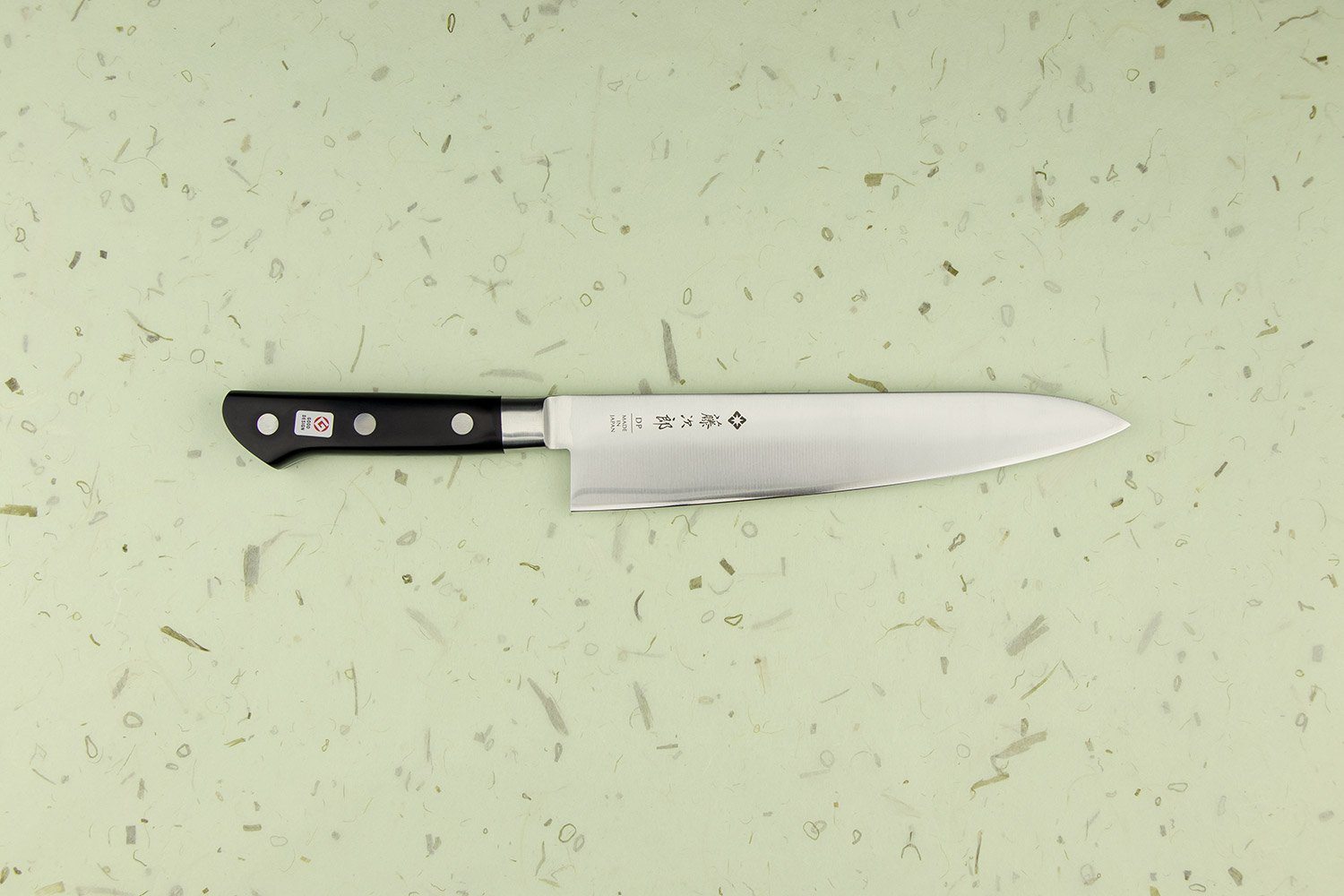
Tojiro
Tojiro DP Gyuto 210mm
Tojiro’s factory production means consistency. Every Tojiro DP Gyuto 180mm that comes off the line should perform like every other one. That predictability is valuable at the entry level, where a bad first experience with a Japanese knife can turn someone off entirely.
The company rebranded its DP line as the “TOJIRO CLASSIC” series in recent years, though many retailers still use the DP name. The knives are identical.
Global by Yoshikin: The Design Revolution
Global knives look like nothing else. The all stainless construction, with blade and handle formed from a single piece of CROMOVA 18 stainless steel, was unprecedented when Yoshikin introduced it in 1983. The dimpled handle provides grip without traditional handle materials. The design hasn’t fundamentally changed in over 40 years because it didn’t need to.
Yoshikin (Yoshida Metal Industry) was founded in 1954 in Tsubame as a Western tableware manufacturer. The decision to apply Tsubame’s stainless steel expertise to kitchen knives was transformative. CROMOVA 18 (an abbreviation for chromium, molybdenum, and vanadium with 18% chromium content) is ice tempered to 56 to 58 HRC, lower than most Japanese knives but paired with a thinner edge geometry than Western equivalents.
The Global G-2 Gyuto 200mm and Global G-48 Santoku 180mm are the bestsellers. They won’t hold an edge as long as harder steels like VG-10 or SG2, but they’re nearly indestructible, completely stain proof, and easy to resharpen.


Global divides the knife community. Purists dismiss the relatively soft steel and non-traditional design. Practical cooks appreciate the zero maintenance and light weight. Both positions have merit. What’s undeniable is that Global brought Japanese cutlery to a global audience that had never considered it before.
Yoshikane Hamono: A Century of Sanjo Forging
Yoshikane is the antithesis of factory production. Founded in 1919 in Sanjo, the company has been hand forging blades for over a century across four generations. The current head, Kazuomi Yamamoto (fourth generation), continues to forge every blade by hand using traditional methods.
Yoshikane is best known for its SKD series. SKD is a semi-stainless tool steel with roughly 7% chromium, placing it between carbon steel (which rusts) and full stainless (which doesn’t). It’s a deliberate compromise: SKD takes a keener edge than most stainless steels and holds it well, while resisting corrosion better than pure carbon steels like Shirogami or Aogami. You still need to dry it after use, but it won’t rust if left damp for a few minutes.
The Yoshikane SKD Gyuto 210mm is a regular recommendation on r/chefknives and r/TrueChefKnives. The nashiji (pear skin) finish, wa handle, and hand forged blade geometry put it in a different category from anything Tojiro or Global produces. These are knives made one at a time by a blacksmith who also produces the grind.
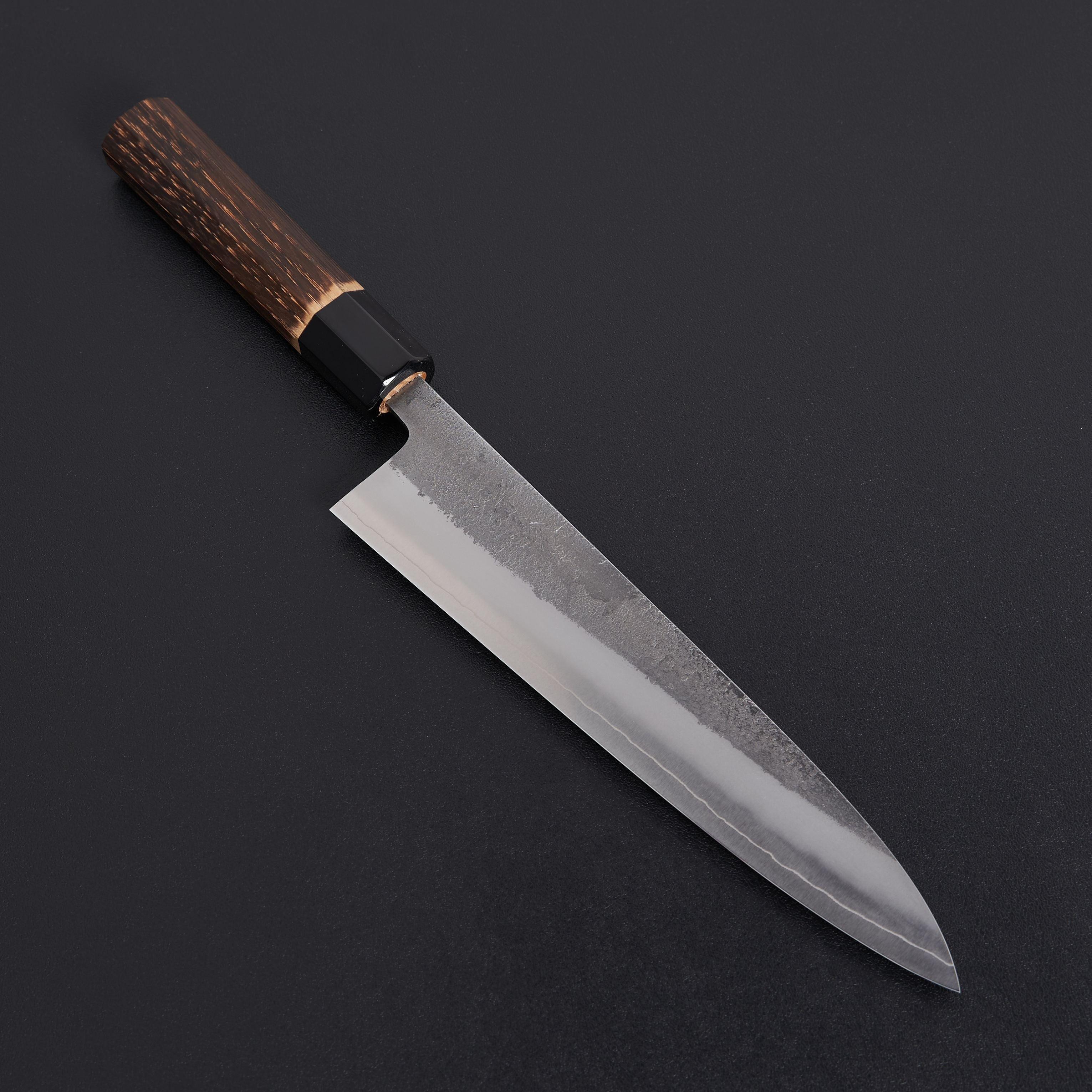
Yoshikane
Yoshikane SKD Gyuto 210mm
The Yoshikane forge also produces blades for other brands and retailers under OEM arrangements, a common practice in Sanjo. If you’ve bought a hand forged Sanjo knife from a boutique retailer, there’s a reasonable chance Yoshikane made the blade.
The Yoshikane SKD Nashiji Nakiri 165mm applies the same SKD steel and nashiji finish to a vegetable knife format. Yoshikane nakiri are prized for their thin, flat grinds, which produce exceptionally clean cuts through produce.
Mazaki: The Apprentice Who Became a Master
Mazaki is one of the newer names in the Sanjo knife scene, but the skills behind it are old. The blacksmith behind Mazaki trained under the Yoshikane family, learning the traditional Sanjo forging techniques before establishing his own forge.
Mazaki knives use Shirogami #2 (White Steel #2), a pure carbon steel from Proterial (formerly Hitachi Metals) with 1.05 to 1.15% carbon content and no chromium. This is steel that rusts. It also takes one of the keenest edges of any knife steel and is relatively easy to sharpen on whetstones.
The Mazaki Kasumi Gyuto 210mm has a devoted following among knife enthusiasts. The kasumi (mist) finish, wa handle, and hand forged blade geometry represent the Sanjo forging tradition at its most traditional. These knives aren’t for beginners. Carbon steel requires attention and care. But for experienced cooks who sharpen their own knives, a Mazaki represents exactly what Sanjo forging does best.
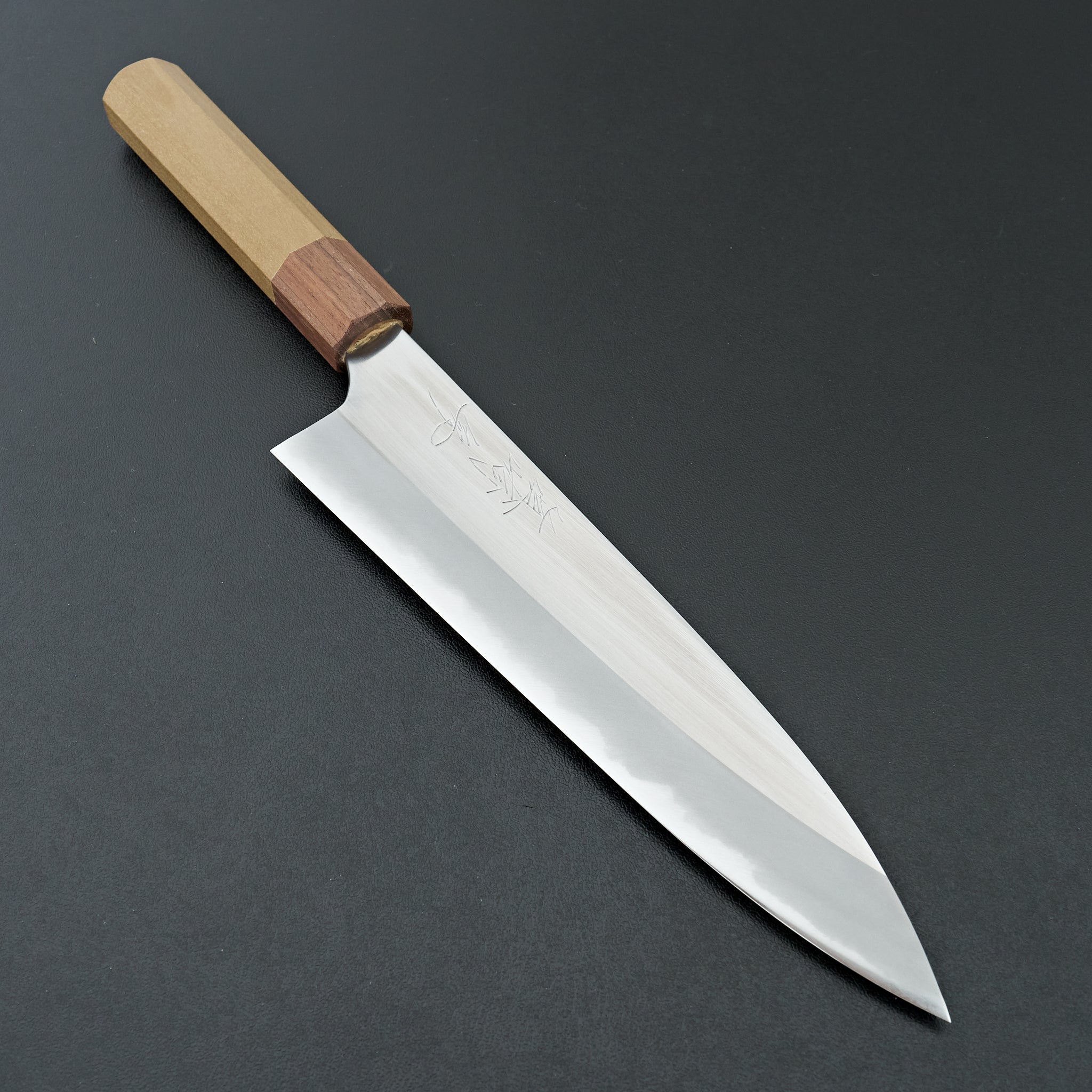
Mazaki
Mazaki Kasumi Gyuto 210mm
Tadafusa: The Bridge Between Traditions
Tadafusa sits somewhere between Tojiro’s factory efficiency and Yoshikane’s artisan tradition. Founded in 1948 in Sanjo, the company hand forges knives using traditional methods but has also developed lines with Western handles and modern steel choices.
The Hocho Kobo (庖丁工房, “Kitchen Knife Workshop”) series, with its distinctive chestnut wood handles and antibacterial finish, is designed for home cooks who want hand forged quality without the learning curve of carbon steel maintenance. The Tadafusa Hocho Kobo HK-2 Santoku 170mm and Tadafusa Hocho Kobo HK-4 Gyuto 210mm use SLD steel (a semi-stainless tool steel similar in concept to Yoshikane’s SKD), giving them good edge retention with moderate corrosion resistance.


Tadafusa also produces bread knives that have gained a cult following. Their scalloped edge design cuts cleanly through crusty bread without crushing the interior. The company has been making knives by hand in Sanjo since 1948, and their Sanjo workshop is one of the factories that opens during the annual Kouba no Saiten.
Tsubame vs. Sanjo: A Tale of Two Traditions
The differences between the two cities are worth understanding because they directly affect the knives.
Tsubame is the factory and finishing center. Stainless steel is the primary material. Production is mechanized (stamping, laser cutting, CNC grinding) with hand finishing. Knives tend to be more consistent piece to piece but less individual. This is where Tojiro and Global/Yoshikin operate. If your priority is reliability, stain resistance, and value, Tsubame knives deliver.
Sanjo is the forging center. Carbon and semi-stainless steels dominate. Blades are forged individually over charcoal fires, shaped by hammer. Every knife has slight variations in grind, finish, and profile. This is where Yoshikane, Mazaki, and Tadafusa work. If your priority is cutting performance, patina character, and the connection to a specific blacksmith, Sanjo knives are where to look.
Neither approach is inherently better. A Tojiro DP Gyuto 210mm at the budget tier will outperform most European knives regardless of price. A Yoshikane SKD Gyuto 210mm at the mid to premium tier will cut differently from every other Yoshikane gyuto because each one is hand forged. Different priorities, different knives.
The region as a whole is also distinct from Sakai (which separates forging, sharpening, and handle making across three specialists) and Seki (which is dominated by large corporate manufacturers like KAI Group and Zwilling’s Miyabi line). Tsubame-Sanjo has both factory and artisan production under one regional umbrella.
Beyond Knives: The Full Metalworking Ecosystem
Understanding Tsubame-Sanjo only as a knife region misses the bigger picture. The area is Japan’s most important metalworking cluster, period.
Tsubame produces an estimated 90% of Japan’s metal tableware. Western style forks, knives, and spoons made in Tsubame have been used at the Nobel Prize Banquet in Stockholm. Gyokusendo, a Tsubame coppersmith, hand hammers copper kettles and sake vessels using techniques passed down since 1816.
Sanjo produces everything from carpentry tools and garden scissors to outdoor recreation equipment. Snow Peak, the premium camping brand, was founded in Sanjo in 1958 and still manufactures there. Suwada, a Sanjo company, makes nail nippers that are exported worldwide.
This broader metalworking ecosystem matters for knives because it means the region has deep infrastructure: specialized steel suppliers, heat treatment facilities, handle makers, and finishing operations that knife producers can draw on. A Sanjo blacksmith can source materials and services locally that a solo knifemaker in a less developed region would have to handle alone or outsource at higher cost.
Visiting Tsubame-Sanjo
The region is one of the most accessible knife production areas in Japan for visitors, with better year round access than either Sakai or Seki.
Getting There
Tsubame-Sanjo Station is on the Joetsu Shinkansen line. From Tokyo Station, the ride takes about two hours. The station is in Sanjo, so Tsubame based attractions (Tojiro, Yoshikin) require a short local train or taxi ride.
Tojiro Open Factory
The Tojiro Open Factory is one of the best cutlery factory tours in Japan. Open year round (reservations recommended), visitors can watch the entire knife production process from raw steel to finished blade. There’s also a retail shop with factory direct pricing. The facility is in Tsubame City.
Yoshikin Shop
Yoshikin opened a direct retail shop in Tsubame in 2024 (their second, after the Roppongi location in Tokyo). The full Global range is available, and staff can demonstrate the knives.
Tsubame-Sanjo Regional Industries Promotion Center
Located in Sanjo near Tsubame-Sanjo Station, this center includes a showroom displaying metalwork from across the region, a physical goods shop, and information about factory visits. It’s a good first stop for orientation.
Kouba no Saiten (Factory Festival)
The annual Kouba no Saiten (工場の祭典, literally “Factory Festival”) is held in early October, typically spanning four days. Over 100 factories, workshops, and studios across Tsubame and Sanjo open their doors simultaneously. Visitors can watch blacksmiths forge knives, see metal polishers at work, try their hand at copper hammering, and buy products direct from makers.
The 2025 edition ran October 2 to 5. The event has been running since 2013 and has inspired exhibitions as far afield as Japan House London. Check the official Kouba no Saiten website for current year dates and participating factories.
For smaller forge visits outside the festival, some workshops accept visitors by appointment. Contact individual makers directly, as policies vary.
FAQ
What is the difference between Tsubame and Sanjo?
Tsubame and Sanjo are two separate cities in Niigata Prefecture that sit side by side. Tsubame is historically known for tableware, cutlery polishing, and stainless steel production. Sanjo specializes in forged tools, hand-forged kitchen knives, and blacksmithing. Together they form one of Japan’s most important metalworking clusters, with over 5,000 small and medium manufacturers.
What knife brands are made in Tsubame-Sanjo?
Major brands from the region include Tojiro (founded 1953, based in Tsubame), Global by Yoshikin (founded 1954, based in Tsubame), Tadafusa (hand-forged knives in Sanjo since 1948), Yoshikane Hamono (founded 1919 in Sanjo), and Mazaki (trained under Yoshikane, also based in Sanjo). Each represents a different approach, from Tojiro’s factory production to Yoshikane’s century old forge work.
How is Tsubame-Sanjo different from Sakai and Seki?
Sakai uses a division of labor system with separate artisans for forging, sharpening, and handles. Seki is the mass production center, home to large manufacturers like KAI Group and Miyabi. Tsubame-Sanjo sits between these extremes: Sanjo blacksmiths typically forge and sharpen their own blades (similar to Echizen’s Takefu Knife Village), while Tsubame factories combine modern manufacturing with hand finishing. The region is also known for metalwork beyond knives, including tableware, tools, and outdoor equipment.
What is the Tsubame-Sanjo Factory Festival?
The Kouba no Saiten (工場の祭典) is an annual event held in early October where over 100 factories and workshops in the Tsubame-Sanjo area open their doors to the public. Visitors can watch knife forging, metal polishing, and other manufacturing processes firsthand. The event has been running since 2013 and attracts thousands of visitors each year.
Is Tsubame-Sanjo worth visiting for knife enthusiasts?
The region offers some of the best factory tour opportunities in Japan. The Tojiro Open Factory is one of the most comprehensive cutlery factory tours in the country, open year round. Yoshikin (Global) has a shop and showroom in Tsubame. Several smaller forges in Sanjo welcome visitors by appointment. The Tsubame-Sanjo area is roughly two hours from Tokyo via the Joetsu Shinkansen to Tsubame-Sanjo Station.