Best Yanagiba Knives: The Sashimi Knife Guide
Quick Takeaway
- The professional benchmark: Masamoto KS Hongasumi Yanagi 270mm. The yanagiba that working sushi chefs aspire to own. Expensive, worth it.
- Best overall value: Sakai Takayuki Kasumi Yanagiba 270mm in Shirogami #2. Classic Sakai craftsmanship, excellent grind, fair price.
- Best for low maintenance: Sakai Takayuki Ginsan Yanagiba 240mm. Near carbon performance without the rust anxiety.
- Best budget entry: Tojiro DP Yanagiba 210mm. The knife r/chefknives recommends when someone says “I want to try sashimi at home.”
- Most honest advice: If you are a home cook, read the next section before buying any yanagiba. You might want a sujihiki instead.
- Key sizing rule: 240mm for home use, 270mm for serious work, 300mm for professionals working whole fish.
- Single bevel knives require sharpening skills. If you cannot sharpen on a whetstone, learn before buying a yanagiba.
Do You Need a Yanagiba?
Before spending serious money on a single bevel knife, the honest question: do you need one?
This is the first thing the community at r/chefknives brings up in every “which yanagiba should I buy” thread, and for good reason. A yanagiba is a specialist’s knife. It does one thing (slice raw fish) better than anything else, but it comes with real tradeoffs.
Single bevel sharpening is hard. This is the number one thing that catches people off guard. You cannot just run a yanagiba through a pull through sharpener or hand it to most knife sharpening services. Maintaining the flat ura side, holding the correct angle on the bevel, and not destroying the urasuki (concavity) requires practice and knowledge. If you have never sharpened on a whetstone before, you should learn on a double bevel knife first.
A sujihiki handles 95% of home fish cutting. A sujihiki is a double bevel slicer that works beautifully on raw fish, cooked meats, and everything in between. Easier to use, much easier to sharpen, more versatile. For home cooks who prepare sashimi a few times a month, a good sujihiki is the smarter buy.
So who should get a yanagiba?
- You prepare sashimi or nigiri regularly and care about cut quality at a professional level
- You can already sharpen on a whetstone (or are genuinely committed to learning)
- You understand that this knife does one thing and you want the best tool for that one thing
If that sounds like you, keep reading. If you are on the fence, start with our sujihiki guide and come back when you are ready.
What Is a Yanagiba?
The yanagiba is the knife behind every perfect slice of sashimi. Its name means “willow leaf blade” (柳刃), describing the long, narrow, single bevel blade designed for one specific job: pulling through raw fish in a single, uninterrupted stroke. No other knife does this as well.
Unlike a gyuto or sujihiki, the yanagiba is sharpened on one side only. This single bevel grind creates an edge geometry that separates fish fibers cleanly rather than crushing them. The result is a slice with a smooth, almost glassy surface that catches light differently, tastes different on the tongue, and holds together better as nigiri topping.
What Makes a Good Yanagiba
Three things separate a good yanagiba from a mediocre one: the grind, the steel, and the length.
The Grind
The single bevel grind is everything. The flat side (ura) should have a subtle concavity (urasuki) that reduces drag as you pull through fish. The bevel side (shinogi) should transition smoothly from spine to edge with no uneven spots. A bad grind on a yanagiba is worse than a bad grind on a double bevel knife because you cannot easily correct it without advanced sharpening skills.
Most yanagiba from established Sakai makers ship with competent grinds. Budget options and mass produced knives are where grind quality becomes a gamble.
Steel
Traditional yanagiba use carbon steel, and for good reason. Carbon steel takes a finer edge than stainless, and edge quality matters more on a yanagiba than almost any other knife type.
Shirogami #2 (White Steel #2) is the workhorse choice. Carbon content around 1.05 to 1.15%, hardness typically 62 to 64 HRC. Takes a screaming sharp edge, sharpens easily, and is forgiving during sharpening practice. This is what most sushi chefs train on and many continue using throughout their careers.
Shirogami #1 (White Steel #1) has higher carbon (1.25 to 1.35%) and reaches slightly higher hardness. Marginally better edge retention than #2, but less forgiving to sharpen. A meaningful upgrade for experienced sharpeners.
Aogami #2 (Blue Steel #2) adds tungsten and chromium to the steel composition, improving edge retention and adding slight wear resistance. Hardness around 62 to 65 HRC. Holds an edge longer than Shirogami but takes more effort to sharpen back to peak performance.
Aogami Super (Blue Super Steel) pushes further with vanadium added alongside the tungsten and chromium. Exceptional edge retention at 63 to 67 HRC, but demanding to sharpen. Best suited to experienced sharpeners who want maximum time between touch ups.
Ginsan (Silver Steel #3) is stainless steel made by Proterial (formerly Hitachi Metals) that performs closer to carbon steel than any other stainless option. No patina, no rust anxiety, and it takes a very fine edge. The tradeoff: slightly less keen than Shirogami at peak sharpness, and some traditional sushi chefs feel the cutting feedback differs from carbon.
Length
Yanagiba typically come in 210mm, 240mm, 270mm, 300mm, and 330mm.
The pull cut technique requires enough blade length to complete the cut in a single stroke. Too short, and you end up sawing back and forth, which defeats the purpose. The rule: your blade should be longer than the widest piece of fish you regularly cut.
210mm: Only useful for cutting maki rolls and very small fish. Too short for proper sashimi work.
240mm: The sweet spot for home use. Handles most fish fillets comfortably and is manageable in a home kitchen.
270mm: The professional standard. Most sushi chefs start here. Long enough for salmon sides and tuna blocks.
300mm and above: For whole fish work and high volume professional cutting. Requires significant counter space and confident technique.
Our Top Picks
The Professional Benchmark: Masamoto KS Hongasumi Yanagi 270mm

Masamoto
Masamoto KS Hongasumi Yanagi 270mm (10.6")
Steel: Shirogami #2 (White Steel #2) Blade Length: 270mm (also available in 240mm and 300mm) Handle: Wa, ho wood with buffalo horn ferrule Grind: Single bevel right Finish: Hongasumi (kasumi)
Any “best yanagiba” list that does not include Masamoto is missing the point. Masamoto Sohonten, based in Tokyo, has been making knives since 1919. The KS line is what you will find behind the counter at high end sushi restaurants worldwide. Jon Broida at Japanese Knife Imports calls it one of the best production yanagibas available, and the r/chefknives community treats it as the standard that other professional yanagiba are measured against.
The KS grind is exceptional. Consistent, refined, and ready for serious work out of the box. The Shirogami #2 steel takes an edge that will make you understand why professionals care about single bevel geometry. The fit and finish reflects a company that has been doing this for over a century.
The tradeoff is price. The KS line runs roughly $300 to $500 depending on length, and availability can be inconsistent outside of major retailers. This is not a beginner’s knife, both in cost and in the skill required to maintain it properly. But if you are serious about sashimi work and want the knife that working professionals trust, this is where you start.
Best Overall Value: Sakai Takayuki Kasumi Yanagiba 270mm
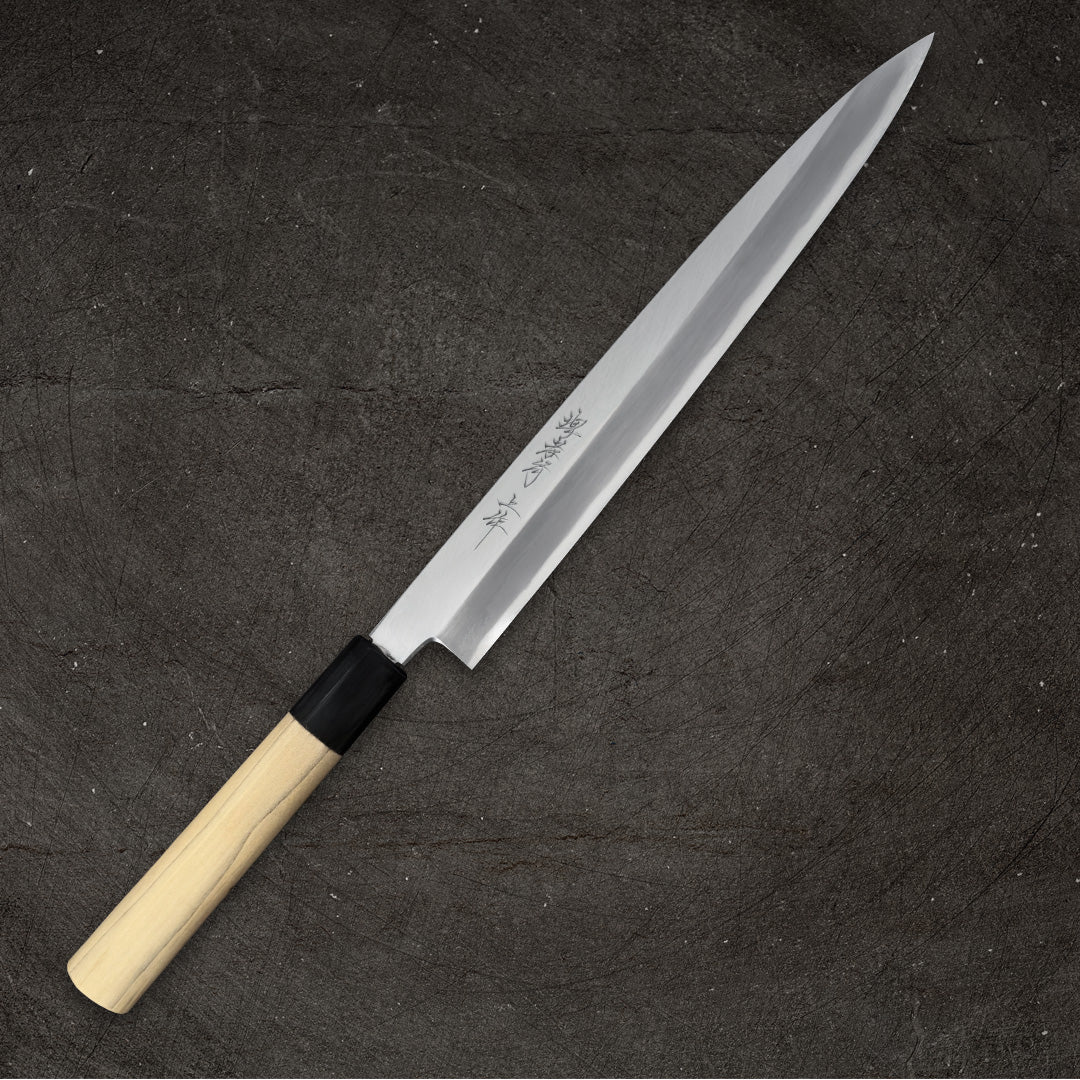
Sakai Takayuki
Sakai Takayuki Kasumi Yanagiba 270mm
Steel: Shirogami #2 (White Steel #2) Hardness: ~62 to 64 HRC Blade Length: 270mm Handle: Wa, magnolia wood with buffalo horn ferrule Grind: Single bevel right Finish: Kasumi (mist)
Sakai Takayuki (the retail brand of Aoki Hamono) has been producing knives in Sakai for generations. Their kasumi yanagiba is a benchmark: traditional Sakai craftsmanship at a price that does not require a second mortgage.
The kasumi finish, where the soft iron cladding contrasts with the hard steel edge, is both functional and beautiful. It provides visual reference for the steel layers and reduces sticking slightly compared to a polished finish.
The grind on Sakai Takayuki’s yanagiba line is consistently good. The urasuki is properly concave, the shinogi line is clean, and the edge comes sharp enough for immediate use (though most sushi chefs will still touch it up on their finishing stone before first use). This is the yanagiba to get if you want a reliable workhorse in Shirogami #2 without overthinking it.
Best for Low Maintenance: Sakai Takayuki Ginsan Yanagiba 240mm Ebony

Sakai Takayuki
Sakai Takayuki Ginsan Yanagiba 240mm
Steel: Ginsan (Silver Steel #3) Blade Length: 240mm Handle: Wa, ebony with buffalo horn ferrule Grind: Single bevel right
Ginsan steel from Proterial is the closest stainless gets to carbon steel performance. This yanagiba takes a very fine edge, holds it respectably, and sharpens without the stubbornness of other stainless steels like VG-10.
The ebony handle is a step up from the standard magnolia wood, adding density and moisture resistance. For home cooks who prep sashimi weekly but do not want to worry about rust developing between sessions, this is the pick.
One honest note: purists and professional sushi chefs overwhelmingly prefer carbon steel yanagiba. They argue (with some justification) that carbon provides a slightly keener edge and different tactile feedback during the cut. If you are pursuing sushi craft seriously, start with carbon. If you want excellent sashimi at home without the maintenance overhead, Ginsan delivers.
Best Budget Entry: Tojiro DP Yanagiba
Tojiro
Tojiro DP Yanagiba 210mm
Steel: Cobalt alloy stainless (VG-10 equivalent) Blade Length: 210mm (also available in longer lengths) Handle: Wa, magnolia wood Grind: Single bevel right
If you search Reddit for “beginner yanagiba” or “first yanagiba,” Tojiro is the name that comes up again and again. At roughly $50 to $80, the Tojiro DP/Pro yanagiba is the lowest risk way to find out whether single bevel fish cutting is something you want to pursue.
The stainless steel will not match a Shirogami blade in peak sharpness, and experienced users will notice the difference on delicate cuts. But for the price, you get a functional single bevel knife that teaches you the pull cut technique and single bevel maintenance without a major financial commitment. If you discover you love sashimi prep, upgrade to a Sakai Takayuki or Masamoto KS later. If the single bevel life is not for you, you have not spent hundreds of dollars finding that out.
Community consensus on r/chefknives: this is a learning knife, not a forever knife. And that is exactly the right role for it.
Sakai Tradition at Mid Range: Sakai Ichimonji Mitsuhide White Steel #2 Kasumi Yanagiba

Sakai Ichimonji Mitsuhide
White Steel #2 Kasumi Yanagiba Knife
Steel: Shirogami #2 (White Steel #2) Blade Length: 180mm, 210mm, 240mm available Handle: Wa, magnolia wood Grind: Single bevel right
Sakai Ichimonji Mitsuhide is a Sakai institution. Their entry level Shirogami #2 kasumi yanagiba gives you a properly made single bevel knife from a legitimate Sakai maker at mid tier pricing.
The grind quality is good for the price, though it may not be as refined as the Sakai Takayuki line. Some users report needing to do initial flattening work on the ura (hollow ground side) out of the box. This is common at this price point and is part of learning single bevel knife maintenance.
Start with the 240mm if this is your first yanagiba. The 180mm is too short for sashimi work and the longer lengths demand more sharpening confidence.
Runner Up: Hitohira Tanaka Manzo 270mm Yanagi Shirogami 2

Hitohira
Hitohira Tanaka Manzo 270mm Yanagi Shirogami 2 Ho Wood with Saya
Steel: Shirogami #2 (White Steel #2) Blade Length: 270mm Handle: Wa, ho wood (D shape) Grind: Single bevel right
Hitohira is a Sakai based brand that sources from established blacksmiths in the region. The Tanaka Manzo line is forged by Manzo Tanaka, a blacksmith known for consistent single bevel grinds. This yanagiba comes with a saya (wooden sheath), which is a practical inclusion for blade protection.
Compared to the Sakai Takayuki, the Hitohira Tanaka Manzo sits at a slightly higher price point but offers a refined grind and the D shape handle provides a more ergonomic hold for extended cutting sessions. If you are stepping up from a budget yanagiba or want your first professional grade sashimi knife, this is an excellent choice.
Worth Considering
Korin House Brand Yanagiba
Korin, widely regarded as one of the most respected Japanese knife retailers in the world, sells their own line of yanagiba made by craftsmen in Sakai. These are frequently recommended in professional sushi communities, particularly among chefs in New York and other cities where Korin has a physical presence. The Korin house brand represents good mid range value from a retailer whose reputation depends on the quality of what they sell. Worth seeking out even though we do not carry them.
Gesshin Yanagiba (Japanese Knife Imports Exclusive)
Jon Broida’s house brand at Japanese Knife Imports (JKI) is one of the most respected names on r/chefknives for good reason. Broida is arguably the most trusted voice in the Japanese knife retail world, and the Gesshin line reflects his standards. The yanagiba offerings are well regarded for their grinds and steel quality. The catch: Gesshin is only available direct from JKI, which limits accessibility. But if you are ordering from JKI, you are also getting the benefit of buying from someone who will answer your emails about sharpening technique for years after the sale.
Hitohira Kikuchiyo Manzo Blue #2 Yanagiba 270mm

Hitohira
Hitohira Kikuchiyo Manzo Blue #2 Yanagiba 270mm Ho Wood Handle (Saya)
Aogami #2 gives you better edge retention than Shirogami while remaining more approachable to sharpen than Aogami Super. The Kikuchiyo line from Hitohira features a kurouchi (forge scale) finish that gives the blade a dark, textured look and reduces surface friction. Comes with ho wood handle and saya.
A solid middle ground between the pure sharpness of Shirogami and the endurance of Aogami Super. A good choice if you want Aogami performance from a trusted Sakai blacksmith.
Moritaka Aogami Super Yanagiba 270mm

Moritaka
Moritaka AS Yanagiba 270mm
Moritaka is a Tosa based maker known for rustic, hardworking knives in Aogami Super steel. Their yanagiba is unconventional: Tosa knives tend toward a rougher, more utilitarian aesthetic compared to the polished elegance of Sakai work. The edge retention is outstanding, but the fit and finish reflects the Tosa tradition of function over beauty.
If you already own and love Moritaka’s work (particularly their gyutos, which is where the brand has its strongest reputation), their yanagiba gives you the same Aogami Super performance in a single bevel format. Not the first yanagiba most people should buy, but a compelling choice for existing Moritaka fans who want consistency across their kit.
Sakai Kikumori Kikuzuki Kasumi Yanagiba 270mm

Sakai Kikumori
Sakai Kikumori Kikuzuki Kasumi Yanagiba 270mm
Sakai Kikumori is another established Sakai house. The Kikuzuki Kasumi line offers a clean kasumi finish yanagiba at premium tier pricing. Less widely discussed online than Sakai Takayuki, but respected within Sakai’s knife making community.
Tsunehisa AUS8 Yanagiba 240mm

Tsunehisa
Tsunehisa AUS8 Yanagiba 240mm
For those firmly in the stainless camp at a lower price point, Tsunehisa offers this AUS-8 yanagiba. AUS-8 is a step below Ginsan in edge taking ability, but it is practically rust proof and easy to maintain. A functional tool rather than a traditional craft knife, best suited to someone who wants to try single bevel cutting without committing to carbon steel.
For Collectors and Professionals
At the luxury tier, yanagiba become individual works of craft. Two examples from our collection:
Sakai Takayuki Homura Guren Yanagiba 300mm represents Sakai Takayuki’s top end: a 300mm yanagiba finished to a level where the blade itself is the statement. Mazaki White #2 Kasumi Yanagiba 300mm from Sanjo brings a different regional tradition to the yanagiba format. Mazaki’s knives, forged by a blacksmith trained under the Yoshikane lineage, have developed a cult following for their grinds.
Beyond our catalog, names like Mizuno Tanrenjo, Suisin, Kagekiyo (by Baba Hamono), Konosuke, and Aritsugu consistently appear in discussions among professional sushi chefs and serious collectors. Aritsugu in particular occupies a legendary status, though acquiring one typically means visiting their shop in Kyoto’s Nishiki Market or their Tsukiji location in person. Honyaki (fully hardened, no cladding) yanagiba from top Sakai blacksmiths represent the pinnacle of the craft, with prices that reflect the difficulty and risk of the honyaki forging process.
Choosing by Experience Level
“I want to try sashimi at home” Start with a sujihiki. Seriously. It will handle home fish cutting beautifully, and you can use it on cooked meats too. If you insist on a yanagiba, the Tojiro DP lets you experiment without a big investment.
“I am serious about fish prep” The Sakai Takayuki Kasumi Yanagiba or Sakai Ichimonji Mitsuhide in Shirogami #2 are the sweet spot. Real Sakai craftsmanship, proper single bevel grinds, prices that reflect value rather than prestige. The Sakai Takayuki Ginsan if you want stainless.
“I am a professional or aspiring professional” The Masamoto KS is the standard for a reason. The Hitohira Tanaka Manzo is an excellent alternative from the Sakai tradition. At this level, seek out retailers like Korin or Japanese Knife Imports who can help you find the right knife for your specific work and hand.
How to Care for a Yanagiba
Single bevel knives demand more maintenance than double bevel knives. Here is what that means in practice.
After every use: Wash immediately with warm water and mild soap. Dry completely. Carbon steel yanagiba will develop rust spots within minutes if left wet. Apply a thin coat of camellia oil (tsubaki oil) if storing for more than a day.
Sharpening: You need at minimum a 1000 grit medium stone and a 3000 to 6000 grit finishing stone. Sharpen the bevel side (shinogi) at the existing angle (typically around 10 to 15 degrees). On the flat side (ura), lay the blade flat and make only light passes to remove the burr. Never raise the spine on the ura side, as this destroys the concavity that makes the yanagiba cut properly.
Storage: Always use the saya (sheath) if one was included. Never store a yanagiba loose in a drawer where the edge can contact other metal.
FAQ
Do I need a yanagiba to make sushi at home?
Most home cooks are better served by a sujihiki. A sujihiki handles 95% of home fish cutting tasks, is much easier to sharpen, and works on cooked proteins too. A yanagiba is designed for professional sashimi service where the texture and appearance of each individual slice matters. If you prepare sashimi or nigiri regularly, you can sharpen on a whetstone, and you want the cleanest possible cuts, then a yanagiba is worth the investment.
What size yanagiba should I get?
For home use, 240mm offers the best balance of control and cutting length. For professional sushi work, 270mm is the standard starting point, with 300mm preferred by experienced chefs working with larger fish. Shorter than 240mm limits your ability to make clean single pull cuts.
What is the best steel for a yanagiba?
Shirogami (White Steel) #2 is the most popular choice for yanagiba knives. It takes an exceptionally keen edge and is relatively easy to sharpen. Aogami (Blue Steel) #2 adds tungsten and chromium for better edge retention. For low maintenance, Ginsan (Silver Steel #3) offers stainless properties while performing close to carbon steel.
What is the difference between a yanagiba and a sujihiki?
A yanagiba is a single bevel knife designed specifically for cutting raw fish with a pull cut technique. A sujihiki is a double bevel slicing knife that works for both raw and cooked proteins. The yanagiba produces cleaner cuts on raw fish due to its single bevel geometry, but requires more skill to use and maintain.
Can left-handed people use a yanagiba?
Standard yanagiba knives are ground for right handed use (single bevel on the right side). Left handed users need a left handed yanagiba, which is ground on the opposite side. These are less common and often cost more, but several Sakai makers produce them. Never use a right handed yanagiba left handed, as the bevel geometry will pull your cuts off line.